Your brief becomes 40 descriptors you can correct before any formula is drafted
The brief reader takes your words, up to twelve images or a mood board, and your website, once. The formula model proposes three formulas, each as notes and a full list of materials with shares summing to 100%.
The brief reader is an open-weight vision-language model we fine-tuned on images our panel described.
The formula model predicts each candidate's scent at one minute, one hour and six hours.
- Read as green, mineral, soft woods; asked for no oud
- Unsure what it cannot call, it asks you about
- Three formulas notes in one line each, all within IFRA limits


Nothing over its IFRA limit for fine fragrance is ever scored, and every allergen over 0.001% goes on your label
0.001%
above this share of a leave-on product, an allergen is named
A proposal the formula model rates a weak match for your brief goes to your perfumer, who rewrites it or asks you a question.
The rules engine strikes them, and anything EU-restricted or refused, before scoring. If nothing within the limits fits your brief well enough, the studio proposes nothing.
Read the EU label ruleThe model proposes the shares. Your perfumer signs them, and you approve last.
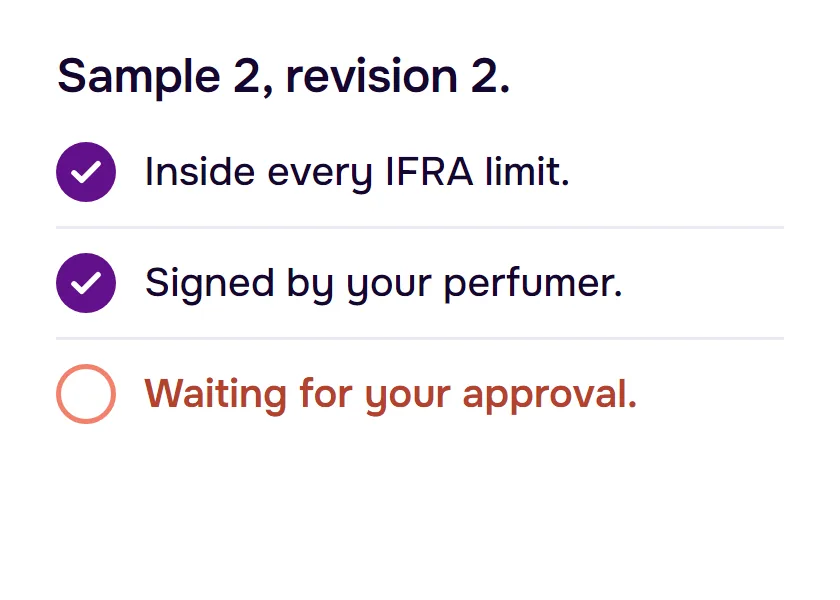
An example: Sample 2, revision 2, as your perfumer reads it, five materials and one accord. Written out, the accord adds 19 materials, 24 in all.
The formula model proposed these shares. It approves nothing.
Your perfumer signed them. You approved last; only your named approver can.
Your brief and the formula you chose are never used to propose a formula for anyone else.
Both models run on cloud GPU capacity we control in Paris and learn from our perfumers' unsold bench formulas, a paid panel's ratings, public odor data and suppliers' documents. Your material list is kept for one job: discarding any later proposal for another brand that shares over 75% of its weight. One AI studio's public terms say its output may not be unique across users.